AI Is Coming for Office Jobs. These Six Trades Are Growing Anyway: Here's the Data.
In March 2026, Anthropic published research that put numbers on something a lot of people had been feeling in their gut. Computer programming: 74.5% of tasks exposed to AI displacement. Customer service: 70.1%. Data entry: 67.1%. If your job involves sitting at a screen, reading documents, writing responses, or processing information, a substantial portion of what you do every day is now in the crosshairs.
The same research found that roughly 30% of the US workforce has near-zero AI task exposure. Those workers are not in corner offices. They are on transmission towers, inside wind nacelles, in data center hot aisles, and on industrial plant floors. They are doing work that requires physical presence, real-time environmental judgment, manual dexterity, and spatial reasoning under variable conditions, the precise combination of capabilities that large language models and robotic systems in 2026 cannot replicate at the task level, let alone at production scale.
This is not a feel-good argument about the nobility of working with your hands. It is a structural observation about where labor demand is outpacing supply right now, and where that gap is widening.
The assumption that a white-collar job is a safer bet than a skilled trade is now empirically backwards in several categories. Here is the data behind six specific roles, all of them sitting inside the power, energy, and critical infrastructure sector, the part of the Next Economy that is growing fastest and hiring hardest.
Why Physical Work Resists the Current Wave
Before the role-by-role breakdown, it is worth being precise about what "AI cannot do this" actually means in 2026. It does not mean these jobs will never change. Instrumentation techs already use AI-assisted diagnostics. HVAC technicians are using predictive maintenance software. The question is task-level displacement: can AI execute the core physical, diagnostic, and judgment-intensive tasks that constitute the job? In every role below, the answer is no, not because of sentiment, but because the physical manipulation, site variability, safety-critical decision-making, and sensory feedback loops required have not been automated in any commercially deployed system.
A lineworker troubleshooting a fault on a distribution circuit during a storm is making dozens of real-time decisions shaped by wind, equipment condition, visual inspection, and touch. No system running in 2026 does that at height, in weather, on a live grid.
Electrical Lineworker
The Bureau of Labor Statistics projects 11% growth for electrical power-line installers and repairers through 2032, nearly three times the average for all occupations. Median pay sits above $85,000, with journeyman lineworkers in high-cost-of-living markets or union shops regularly clearing $100,000 before overtime.
The structural driver is not just grid maintenance. The US is in the early stages of a multi-decade grid expansion driven by electrification of transportation, industrial load growth, and renewable interconnection. Every new solar farm and wind project needs transmission infrastructure. Every EV fleet charging depot needs distribution capacity. That work is done by lineworkers, and utilities are reporting that they cannot hire them fast enough.
Entry path: most utilities and electrical cooperatives run DOL Registered Apprenticeship programs, typically four to five years, paid from day one. No degree required. Veterans with electrical MOS backgrounds, Army 12P, Navy EM rate, Air Force 3E0X1, have direct technical overlap.
Wind Turbine Technician
Wind turbine service technicians appear on the BLS fastest-growing occupations list and have for several consecutive projection cycles. Median entry-level pay is around $61,000, with experienced technicians at large wind farms clearing $75,000 to $85,000 plus site-specific bonuses and travel pay.
The job is physically demanding and technically specific: climbing towers of 200 feet or more, diagnosing electrical and mechanical faults in confined nacelle spaces, performing hydraulic and gearbox maintenance in conditions that vary from desert heat to offshore wind. The diagnostic component is increasingly software-assisted, but the physical execution, torquing bolts to spec at elevation, replacing pitch control components, handling high-voltage systems, requires a trained technician on-site.
Demand is driven by the buildout of new capacity and the maintenance backlog on existing turbines. Turbine manufacturers including Vestas and GE Vernova run their own technician training programs, some as short as 12 months.
Industrial Electrician
Chronically short-staffed across manufacturing, petrochemical, food processing, and semiconductor fabrication, industrial electricians command $75,000 to $95,000 in most US markets, with specialized facilities, chip fabs, LNG terminals, pharmaceutical plants, paying above that band.
The BLS groups industrial electricians within the broader electrician category, which projects 11% growth, but practitioners in the market know the industrial segment is tighter than the aggregate number suggests. Any facility running continuous operations cannot afford electrical downtime, and the specialized knowledge required to work safely in classified hazardous locations, to read and modify PLC ladder logic, and to troubleshoot three-phase industrial systems takes years to develop.
AI can optimize energy consumption in a plant. It cannot safely replace a conduit, commission a motor control center, or diagnose an intermittent fault on a VFD in a live production environment. NCCER certification and a state journeyman license are the standard credentials. DOL apprenticeship programs through IBEW locals cover most major metros.
HVAC-R Technician
The BLS projects 9% growth for heating, air conditioning, and refrigeration mechanics through 2032, with commercial and industrial HVAC technicians well above the median pay figure of approximately $57,000 for the full occupational category. Technicians who specialize in commercial chiller systems, industrial refrigeration, or building automation controls routinely earn $75,000 to $85,000 in high-demand markets.
The growth drivers are multiple: an aging national building stock, tightening EPA refrigerant regulations requiring system upgrades, data center cooling demand, and the electrification of building systems that is converting legacy gas-fired equipment to heat pump technology. Each regulatory and infrastructure shift creates a service and installation wave that requires trained hands.
EPA 608 certification is mandatory for anyone handling refrigerants and is the baseline credential. Full commercial journeyman status typically requires a three-to-five-year apprenticeship. HVAC programs at community colleges and trade schools can get a career-switcher to entry-level employment in 12 to 18 months.
Data Center Critical Facilities Technician
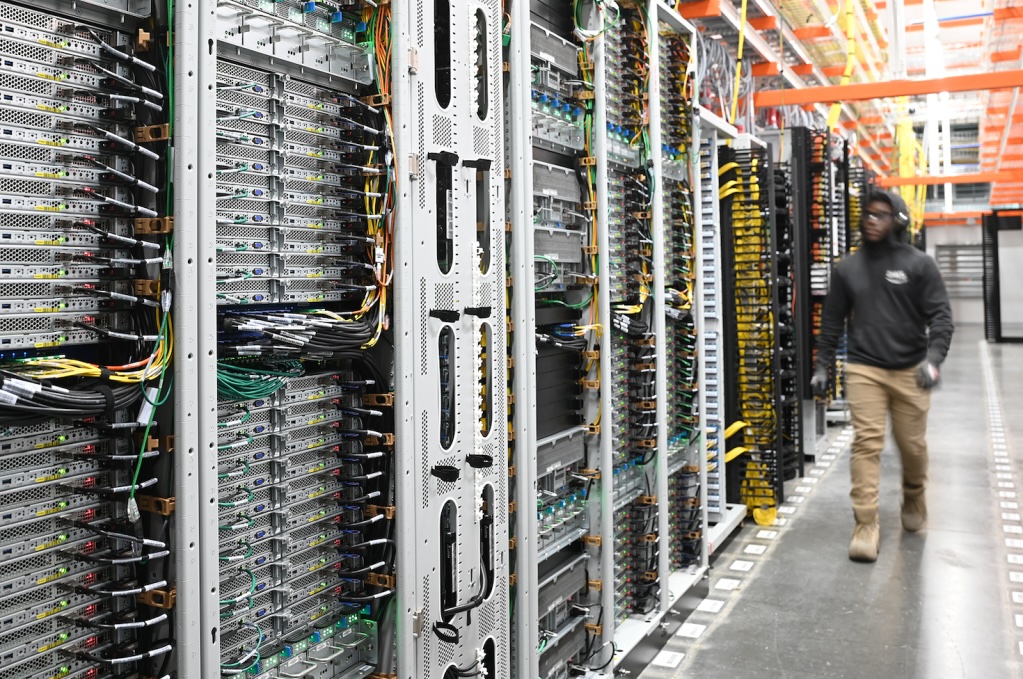
This role sits at the intersection of two of the most capital-intensive build cycles in US infrastructure history: hyperscaler cloud expansion and AI compute infrastructure. Amazon Web Services, Microsoft Azure, Google Cloud, and a wave of colocation operators including Equinix and Digital Realty are building or announcing data centers across every major US region. Each facility requires around-the-clock critical facilities technicians to maintain power, cooling, fire suppression, and physical security systems.
Salary range is $75,000 to $100,000 for experienced technicians, with senior and lead roles at hyperscaler-owned facilities exceeding that. The job requires electrical and mechanical competency, familiarity with uninterruptible power supply systems and backup generators, and the ability to work within strict change management protocols where a mistake can take down production infrastructure serving millions of users.
The irony is precise: the physical infrastructure enabling AI cannot itself be maintained by AI. The servers training the models that are displacing knowledge workers require human technicians to keep them running. Electrical or HVAC backgrounds are the typical entry path; Uptime Institute certifications and vendor-specific training (Schneider Electric APC, Vertiv) are valued credentials.
Instrumentation and Controls Technician
Instrumentation and controls (I&C) technicians calibrate, install, and maintain the measurement and control systems that regulate industrial processes: pressure, temperature, flow, level, and analytical measurements across oil and gas, chemical, power generation, water treatment, and advanced manufacturing facilities.
Median pay in the energy and heavy industry sectors runs $80,000 to $105,000. The role requires understanding of process control theory, loop tuning, signal wiring, and increasingly, industrial networking and cybersecurity as operational technology systems become more connected. It is one of the more technically demanding trades, which is part of why the shortage is severe: the workforce is aging, the training pipeline is thin, and the knowledge base is highly plant-specific.
BLS data groups I&C technicians within the industrial machinery mechanic and electrical instrumentation categories, both of which show positive growth projections. The actual market tightness, particularly in oil and gas refining, LNG facilities, and nuclear power, is more acute than national aggregates capture. NCCER instrumentation credentials and ISA certifications are the primary qualification pathway.
The Entry Path Is Shorter Than You Think
Every role on this list is accessible without a four-year degree. Most are accessible within 12 to 24 months through some combination of trade school, community college programs, and on-the-job training, or within three to five years through a DOL Registered Apprenticeship that pays a wage from day one.
Registered Apprenticeships are the most underutilized workforce development mechanism in the US. The Department of Labor's apprenticeship program database lists active programs in electrical, HVAC, and industrial maintenance trades across every state. Apprentices earn a progressively scaled wage, typically starting at 50% of journeyman rate and rising, while accumulating hours toward certification. There is no tuition debt because the employer absorbs training costs as a condition of the program structure.
For military veterans, the credential crosswalk is often more direct than it appears. An Army 12P (Prime Power Specialist), a Navy EM (Electrician's Mate), or an Air Force 3E0X1 (Electrical Systems) enters any of these civilian pipelines with documented technical training and operational experience that most civilian applicants do not have. VA education benefits and the GI Bill can cover supplemental training costs; SkillBridge can be used for pre-separation industry placements with employers running apprenticeship programs.
For career switchers coming out of knowledge economy roles, the calculation is less familiar but increasingly compelling. A 32-year-old marketing analyst with ten years of experience is staring at a role with 70%-plus AI task exposure and flat or declining wage growth. A 32-year-old entering a four-year IBEW apprenticeship is on a trajectory to $90,000-plus by 36, in a role with structural demand, minimal automation risk in the near term, and portability across every major US labor market.
The data is not ambiguous about which bet looks better right now.
Build Your Profile and See Where You Fit
If any of these six roles caught your attention, the next step is figuring out where your existing background gives you an entry advantage, what credentials you would need, and which employers in your region are actively hiring. Build a free profile on Redeployable and see which of these roles match your background, even if you are starting from scratch. The platform is built specifically for this transition, connecting people moving out of the knowledge economy and out of the military into the trades and sectors where the demand is real and the growth is not theoretical.


.jpeg)